
Saodat Ismailova — Chillahona
 © Saodat Ismailova
Saodat Ismailova is a filmmaker and artist who explores personal and collective memories, reflecting the cultural and socio-political complexities of her native region of Central Asia. Her distinct filmic language combines documentary elements with experimental approaches, that intertwines ancient rituals, myths and recent histories in continuous, multi-layered narratives.
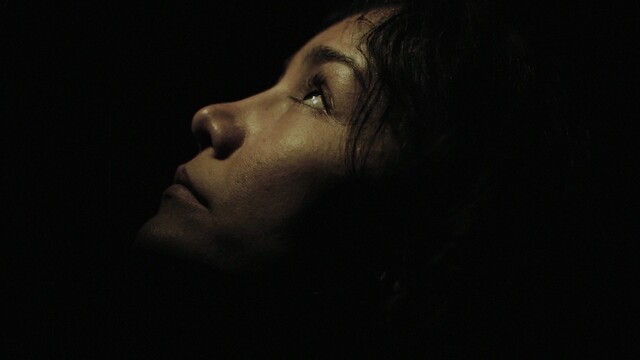
Chillahona (2022) reflects on the significance of marginalised ancestral cultural practices in times of political and social turbulence that characterised Central Asia in the 1980s. Implemented shortly before the dissolution of the Soviet Union, the radical economic and political reforms known as perestroika resulted in a sense of disorientation. Filmed in Tashkent, Uzbekistan, this three-channel video installation refers to an ancient architectural form of underground (chillahona) chamber, which is used in Uzbekistan for 40-day periods of ascetic seclusion. Opening with the archival footage from the perestroika period, the film unfolds a story of a woman who visits the chamber to navigate her memories of such troubled times. Throughout the narration, various archetypical animals accompany the character, manifesting in her reconciliation with ancestral knowledge. Presented alongside the film is a modern reinterpretation of the traditional Tashkent embroidery – falak – which features depictions of the moon cycle, a womb and various animals. It is animated with the light projection inspired by Sufi mysticism, symbolically translating the character’s spiritual experience.
Saodat Ismailova lives and works between Tashkent and Paris. The presentation of work by Ismailova is the result of the long-term partnership between M HKA and the Tselinny Center of Contemporary Culture, Almaty, Kazakhstan. As part of this partnership, the Tselliny generously engages with M HKA through annually acquiring works from the region, and donating them to our museum. These works form the Şağylys collection, which in Kazakh means ‘reflection’.
Click here to browse the digital scan of the exhibition.